Pacific Atlantic Water Flow Problem Solving Tutorial: A Complete Comparison of 3 Solutions | LeetCode 417 Best Practice

Pacific Atlantic Water Flow Problem Solving Tutorial Diagram | LeetCode 417

This article provides a complete breakdown of the solution to LeetCode 417 Pacific Atlantic Water Flow: from the problem-solving approach and algorithm steps to time and space complexity, and also summarizes boundary cases and compares three solutions, helping you understand Pacific Atlantic Water Flow in one go.

Explore diverse LeetCode solutions in Python, C++, JavaScript, SQL, and TypeScript. Ideal for interview prep, learning, and code practice in multiple programming languages. Github Repo Link


There is an xn rectangular island that borders both the Pacific Ocean and Atlantic Ocean.The Pacific Ocean touches the island's left and top edges, and the Atlantic Ocean touches the island's right and bottom edges.

The island is partitioned into a grid of square cells. You are given an xn integer matrix heights where heights[r][c] represents the height above sea level of the cell at coordinate (r, c).

The island receives a lot of rain, and the rain water can flow to neighboring cells directly north, south, east, and west if the neighboring cell's height is less than or equal to the current cell's height. Water can flow from any cell adjacent to an ocean into the ocean.

Return a 2D list of grid coordinates result where result[i] = [r i , c i ] denotes that rain water can flow from cell (r i , c i ) to both the Pacific and Atlantic oceans.

Example 1:
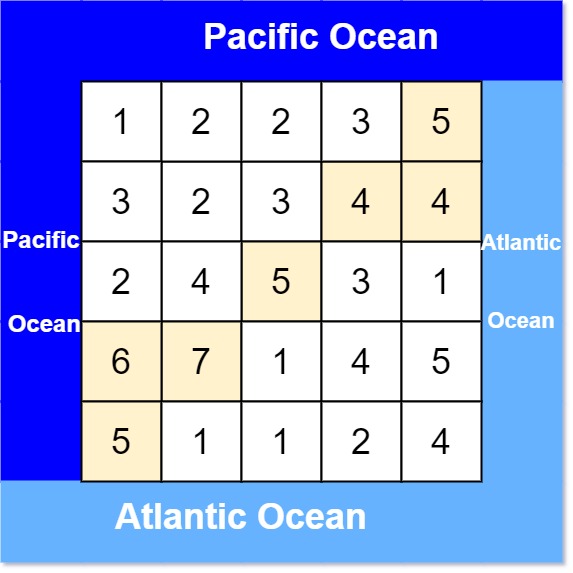
Input: heights = [[1,2,2,3,5],[3,2,3,4,4],[2,4,5,3,1],[6,7,1,4,5] ,[5,1,1,2,4]]
Output: [[0,4],[1,3],[1,4],[2,2],[3,0],[3,1],[4,0]]
Explanation: The following cells can flow to the Pacific and Atlantic oceans, as shown below: [0,4]: [0,4] -> Pacific Ocean [0,4] -> Atlantic Ocean [1,3]: [1,3 ] -> [0,3] -> Pacific Ocean [1,3] -> [1,4] -> Atlantic Ocean [1,4]: [1,4] -> [1,3] -> [0 ,3] -> Pacific Ocean [1,4] -> Atlantic Ocean [2,2]: [2,2] -> [1,2] -> [0,2] -> Pacific Ocean [2,2] -> [2,3] -> [2,4] -> Atlantic Ocean [3,0]: [3,0] -> Pacific Ocean [3,0] -> [4,0] -> Atlantic Ocean [ 3,1]: [3,1] -> [3,0] -> Pacific Ocean [3,1] -> [4,1] -> Atlantic Ocean [4,0]: [4,0] -> Pacific Ocean [4,0] -> Atlantic Ocean Note that there are other possible paths for these cells to flow to the Pacific and Atlantic oceans.

Example 2:

Input: heights = [[1]]
Output: [[0,0]]
Explanation: The water can flow from the only cell to the Pacific and Atlantic oceans.

Constraints:

  • m == heights.length
  • n == heights[r].length
  • 1 <= m, n <= 200
  • 0 <= heights[r][c] <= 10 5

Python

				
					# time complexity: O(m*n) # space complexity: O(m*n) from collections import deque from typing import List class Solution: def pacificAtlantic(self, heights: List[List[int]]) -> List[ List[int]]: ROW = len(heights) COL = len(heights[0]) if not ROW or not COL: return [] directions = [(1, 0), (-1, 0), (0, 1), (0, -1)] pacificQueue = deque() atlanticQueue = deque() for i in range(ROW): pacificQueue.append((i, 0)) atlanticQueue.append((i, COL - 1)) for i in range(COL): pacificQueue.append((0, i)) atlanticQueue.append((ROW - 1, i)) def bfs(queue): reachable = set() while queue: currX, currY = queue. popleft() reachable.add((currX, currY)) for (dX, dY) in directions: nextX = currX + dX nextY = currY + dY if nextX < 0 or nextX >= ROW or nextY < 0 or nextY >= COL : continue if (nextX, nextY) in reachable: continue if heights[currX][currY] > heights[nextX][nextY]: continue queue.append((nextX, nextY)) return reachable pacificSet = bfs(pacificQueue) atlanticSet = bfs(atlanticQueue) return list(pacificSet.intersection(atlanticSet)) heights = [[1, 1], [1, 1], [1, 1]] print(Solution().pacificAtlantic(heights))


Pacific Atlantic Water Flow Problem Solving Approach

Forward thinking (flowing outward from each cell) involves repeatedly calculating numerous paths. Reverse thinking is key: "going against the current" from the ocean boundary inland, only reaching neighbors with a height greater than or equal to the current cell. Run a search once from the Pacific and once from the Atlantic boundary; the intersection of the two reachable sets is the answer.

Pacific Atlantic Water Flow Algorithm Steps

  1. Establish two Boolean matrices, pacific and atlantic.
  2. Perform a depth-first search (DFS) starting from all cells on the top and left boundaries, marking them as reachable from pacific.
  3. Perform a depth-first search (DFS) starting from all cells on the bottom and right boundaries, marking them as reachable from the Atlantic.
  4. During DFS, only move to the neighbors whose height is greater than or equal to the current cell; finally, collect the coordinates of both matrices that are true.

Complexity analysis of Pacific Atlantic Water Flow

projectComplexity
Time complexityO(m·n)
Space complexityO(m·n)

Each cell is visited at most once in each of the two searches, with a time complexity of O(m·n). The two Boolean matrices and the recursive stack are both O(m·n). The reverse search compresses what could have been an exponential path into a linear one.

Boundary conditions and common errors in Pacific Atlantic Water Flow

  • The condition for reverse flow is "neighbor's height >= current height", so don't write the direction in reverse.
  • The corner square belongs to the boundary of two oceans at the same time and should be the starting point in both searches.
  • Adjacent cells of the same height can move between each other, provided that the condition is greater than or equal to.
  • An empty matrix is directly returned to an empty array.

Comparison of other solutions for Pacific Atlantic Water Flow

solutiontimespaceillustrate
For each cell, perform a forward DFS to check if it's possible to reach the two oceans.O((m·n)²)O(m·n)Serious double counting
BFS flows backward from the boundary.O(m·n)O(m·n)Equivalent to DFS
Bidirectional reverse flow DFS to find the intersectionO(m·n)O(m·n)This article adopts